
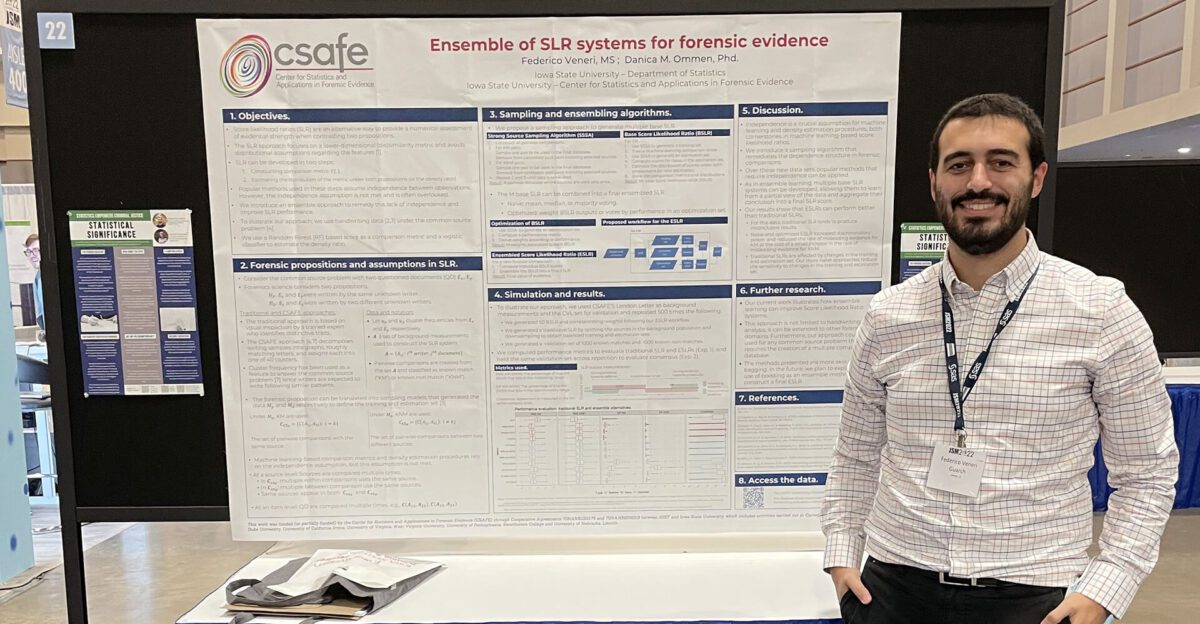
Federico Veneri, a Ph.D. student in statistics, tied for second place in the Statistical Significance poster competition at the Joint Statistical Meetings. His poster was titled, “Ensemble of SLR Systems for Forensic Evidence.”
Posted August 30, 2022
Researchers from the Center for Statistics and Applications in Forensic Evidence (CSAFE) presented papers and posters at the Joint Statistical Meetings (JSM) on Aug. 6-11 in Washington, D.C. Federico Veneri, a CSAFE Ph.D. candidate in statistics, tied for second place in the Statistical Significance poster competition at the meeting.
Veneri’s poster, “Ensemble of SLR Systems for Forensic Evidence,” introduces a solution to help strengthen the statistical foundations of forensic evidence interpretation.
Forensic experts are often asked to assess how likely two items are in terms of their source. For example, if two bullets came from the same gun or two questioned documents were written by the same writer. According to Veneri, it would be great if we could assess how similar two items are by way of an objective similarity score and attach some probabilities statements such that judges and jurors can interpret those scores correctly.
“CSAFE has made great advances by providing researchers and practitioners with these similar scores in several forensic domains: shoeprints, bullets and handwriting evidence,” he said. “Our work deals with using those scores to compute score-based likelihood ratios to attach some probability statements to the values found.”
Veneri said that the standard approach for constructing those scores and likelihood ratios is for researchers to use machine learning-based comparison metrics and density estimation procedures that rely on an independence assumption that is not met in practice. He said his research proposes a sampling algorithm called Ensembled Score Likelihood Ratios.
His research shows that Ensembled Score Likelihood Ratios perform better than their traditional counterparts, providing stronger, more stable, and less misleading evidence.
Veneri has plans to continue working on this project in the future. “So far, we have tested our approach for handwriting and glass evidence,” he said. “We hope we can expand our results to other forensic domains and to other statistical problems that require the use of pairwise comparison.”
He noted that attending JSM and participating in the competition was a wonderful experience. “The competition highlights the contributions that statisticians make to society. It was a great opportunity to learn about different fields and how statistics play a fundamental role in each of them,” he said.
Veneri currently studies under Danica Ommen, an assistant professor of statistics at Iowa State and co-author of the poster. Ommen’s research in statistical foundations aims to validate and assess the reliability of score-based likelihood ratios for forensic evidence comparison.
He received his bachelor’s degrees in economics and statistics and a master’s degree in mathematical engineering from the Universidad de la Republica in Uruguay. In 2018, Veneri was awarded a Fulbright Scholarship by the Fulbright Commission and the Uruguayan National Agency of Research and Innovation. They provided the support for his first two years at Iowa State, where he received his master’s degree in statistics in 2021.
He decided to attend Iowa State because he was interested in statistical applications in public policy and criminal justice and was immediately drawn to CSAFE. “During my second year, I got the opportunity to talk with Dr. Ommen and Dr. Alicia Carriquiry to learn more about CSAFE’s mission, and began working with Dr. Ommen on what would become my master’s creative component shortly after,” Veneri said.
Veneri’s poster and one-page handout can be viewed at https://github.com/fveneri/JSM-2022.
In addition, three CSAFE researchers presented posters in the Contributed Speed and Poster Presentations sessions at JSM. Below is the list of researchers with a link to view their posters. An asterisk (*) denotes the presenter.
Reliability for Binary and Ordinal Data in Forensics
Hina Arora*, Ph.D. student in statistics at the University of California, Irvine; Naomi Kaplan-Damary, lecturer at the Institute of Criminology, Faculty of Law at The Hebrew University of Jerusalem; and Hal Stern, CSAFE co-director and Provost and Executive Vice Chancellor and Chancellor’s Professor of Statistics at the University of California, Irvine
View Poster
Likelihood Ratios for Categorical Evidence with Applications to Digital Forensics
Rachel Longjohn*, Ph.D. student in statistics at the University of California, Irvine; and Padhraic Smyth, Chancellor’s Professor in computer science and statistics at the University of California, Irvine
View Poster
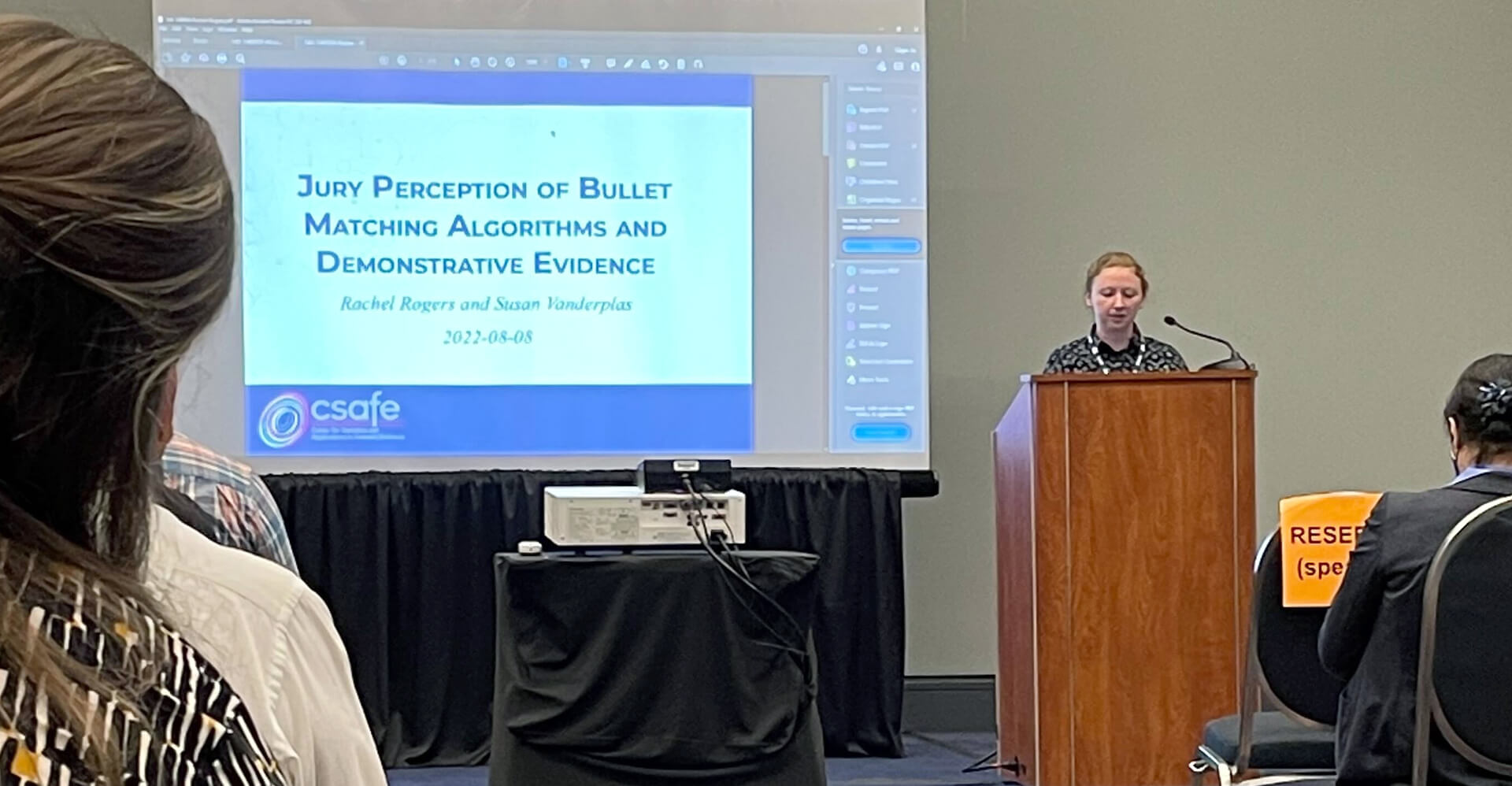
Jury Perception of Bullet Matching Algorithms and Demonstrative Evidence
Rachel Rogers*, Ph.D. student in statistics at the University of Nebraska-Lincoln; and Susan VanderPlas, assistant professor of statistics at the University of Nebraska-Lincoln
View Poster
Several CSAFE researchers presented papers or organized sessions during the meeting. For the full list of CSAFE presentations, visit https://forensicstats.org/news-posts/csafe-researchers-to-present-research-findings-at-jsm/.
From the Blog
Recent Posts
Keynote Speakers Announced for ICFIS 2026
August 10, 2026
The Scientific Committee for the 12th International Conference on Forensic Inference and Statistics is pleased to announce the keynote speakers …
CSAFE Researchers will be Panel Speakers at NAFSB 2026 Conference
August 7, 2026
The annual National Association of Forensic Science Boards (NAFSB) Conference will be Oct. 13-16 at the Milwaukee Crime Lab Bureau …
ICFIS 2026 Moves Online, Abstract Deadline Extended to Aug. 17
July 27, 2026
The 12th International Conference on Forensic Inference and Statistics (ICFIS) will now be an online-only event, allowing participants from around the world …