
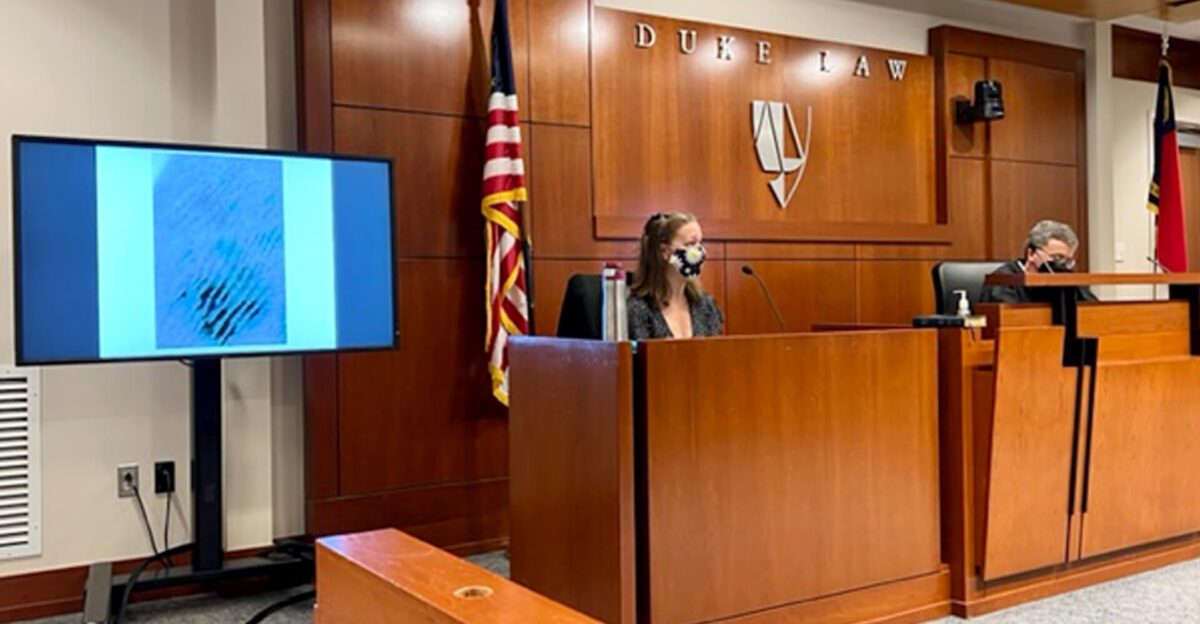
The annual CSAFE-supported course at Duke Law, where law students prepare, proffer and cross-examine a fingerprint examiner, pictured here played by Heidi Eldridge of RTI International. Photo courtesy of the Wilson Center for Science and Justice at Duke Law.
Posted April 26, 2022
More than a decade has passed since the 2009 National Academy of Sciences Report called for higher-quality scientific education in law schools, citing a lack of scientific expertise among lawyers and judges. So, have law schools added forensic science courses to their curricula since the report was released?
To answer that question, researchers funded by the Center for Statistics and Applications in Forensic Evidence (CSAFE) conducted searches to find out how many U.S. law schools offer forensic science courses and then surveyed the instructors for more information.
The study was led and recently published by Brandon Garrett, CSAFE co-director and the L. Neil Williams, Jr. Professor of Law and director of the Wilson Center for Science and Justice at Duke University; Glinda Cooper, former director of science and research at the Innocence Project; and Quinn Beckham, a student at Duke University.
The researchers searched online course listings for 192 law schools included on the 2019 News and World Report ranking list. They identified just 42 forensic science courses at law schools, not including continuing legal education programs.
“That initial search for forensic science courses already supports what commentators have observed: that forensic science course offerings at law schools are not common,” the researchers write.
They then sent surveys to instructors who teach each course and requested syllabi to examine the coverage of forensic science courses the schools offered. They received 22 responses.
The responses further described how exceptional it is for law school to offer a forensic science course. Overall, the researchers found that the courses were upper-level seminars, and many were not offered each year. The survey also suggested a lack of demand to support larger or annual offerings. Some responses reported caps on class size, and others reported typical class sizes of under 20 students. None of the courses were large lectures. The researchers noted that four courses were no longer being taught at the time of their survey.
After examining the syllabi, they found that almost all covered legal standards for admissibility of expert evidence. Only two courses mentioned teaching statistics or quantitative methods.
“This survey suggests that in the 12 years that have passed since the National Academy of Sciences report was published, we have not seen anything like a surge in offerings regarding forensic science. Moreover, the law school courses that are offered often do not focus on statistics or scientific methods; they are typically introductory or discussion seminar courses,” the researchers write.
The researchers propose that besides specialty courses in forensic science, more general courses in quantitative methods during and after law school could provide a better understanding of statistics for future and current lawyers and judges.
“More fundamentally, the results suggest that far more should be done to ensure scientific literacy in the legal profession, beginning in law school, but also continuing throughout the professional careers of practicing lawyers,” the researchers explain.
Download the journal article and read insights from this study at forensicstats.org/blog/2021/02/28/insights-forensic-science-in-legal-education/.
CSAFE provides education and training programs on probability and statistics applied to forensic science and the courtroom. Explore CSAFE’s learning opportunities by visiting forensicstats.org/legal-community.
From the Blog
Two Journals for Sharing Your Forensic Science and Statistics Research
If you’re looking for a journal to showcase your latest research findings, consider exploring these …
NIST Report Highlights Key Challenges in Forensic Science and Provides Strategies for Addressing Them
In September, the National Institute of Standards and Technology (NIST) released a new report titled …
Recent Posts
Keynote Speakers Announced for ICFIS 2026
August 10, 2026
The Scientific Committee for the 12th International Conference on Forensic Inference and Statistics is pleased to announce the keynote speakers …
CSAFE Researchers will be Panel Speakers at NAFSB 2026 Conference
August 7, 2026
The annual National Association of Forensic Science Boards (NAFSB) Conference will be Oct. 13-16 at the Milwaukee Crime Lab Bureau …
ICFIS 2026 Moves Online, Abstract Deadline Extended to Aug. 17
July 27, 2026
The 12th International Conference on Forensic Inference and Statistics (ICFIS) will now be an online-only event, allowing participants from around the world …