
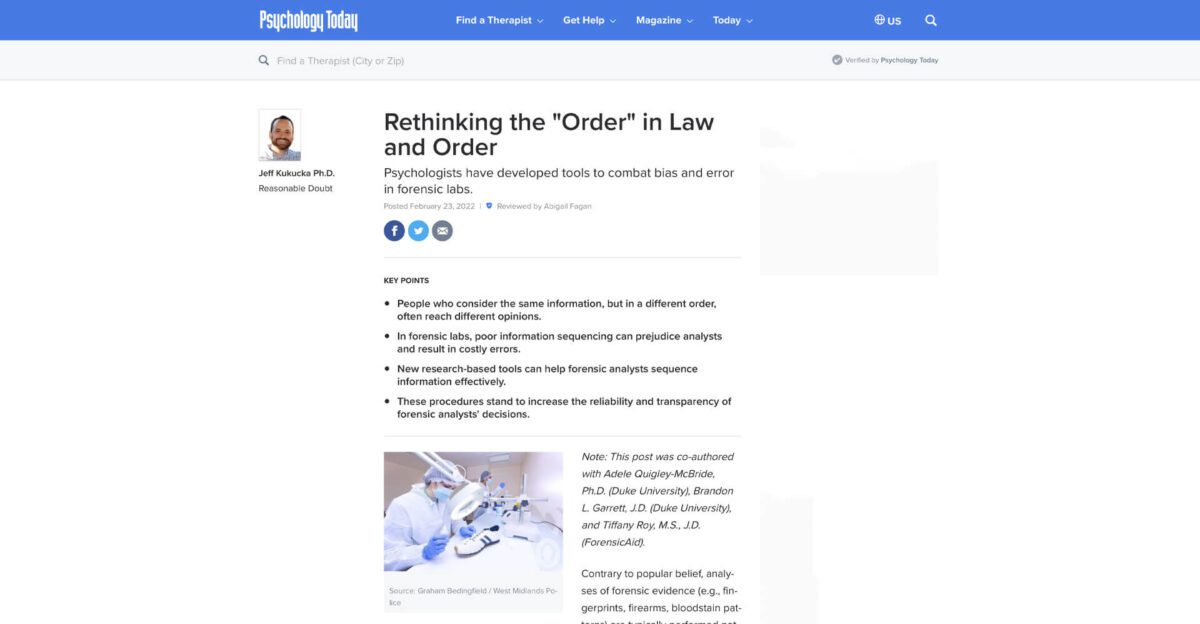
CSAFE researchers wrote an article for Psychology Today that discusses their latest publication.
Posted March 18, 2022
Researchers from the Center for Statistics and Applications in Forensic Evidence (CSAFE) wrote an article for Psychology Today that discusses their latest publication, “A practical tool for information management in forensic decisions: Using Linear Sequential Unmasking-Expanded (LSU-E) in casework.”
The article was co-authored by Jeff Kukucka, an associate professor of psychology at Towson University; Brandon Garrett, CSAFE co-director and the L. Neil Williams, Jr. Professor of Law and director of the Wilson Center for Science and Justice at Duke University; and Adele Quigley-McBride, a post-doctoral fellow at Duke University, along with Tiffany Roy from ForensicAid.
To provide guidance on how forensic laboratories can take practical steps to minimize error, the authors developed a worksheet that labs and analysts can use to document and optimize their decision-making processes. The worksheet is free to download and can be tailored to any forensic discipline.
Excerpt from the article:
To encourage and facilitate the use of LSU-E, we recently developed and published a worksheet that analysts can use to record the sources of information that guided their analysis and when they considered each. The worksheet walks analysts through their consideration of the information available to them, asks them to rate each item along three criteria (objectivity, relevance, and biasing power), and encourages them to describe any steps taken to mitigate its potential biasing effect.
In addition, we developed training materials and examples of how to rate and consider different kinds of information that are often available to analysts. In theory, this worksheet should also help non-experts (e.g., judges and juries) make informed decisions about the trustworthiness of the resulting forensic opinion by increasing transparency about the basis for the analyst’s opinion, whether and how their opinion evolved over time, and whether they took appropriate steps to avoid bias.
To read the full article from Psychology Today, go to https://www.psychologytoday.com/us/blog/reasonable-doubt/202202/rethinking-the-order-in-law-and-order.
To read the publication and download the worksheet, visit https://forensicstats.org/blog/portfolio/a-practical-tool-for-information-management-in-forensic-decisions-using-linear-sequential-unmasking-expanded-lsu-e-in-casework/.
From the Blog
Two Journals for Sharing Your Forensic Science and Statistics Research
If you’re looking for a journal to showcase your latest research findings, consider exploring these …

NIST Report Highlights Key Challenges in Forensic Science and Provides Strategies for Addressing Them
In September, the National Institute of Standards and Technology (NIST) released a new report titled …
Recent Posts
Keynote Speakers Announced for ICFIS 2026
August 10, 2026
The Scientific Committee for the 12th International Conference on Forensic Inference and Statistics is pleased to announce the keynote speakers …

CSAFE Researchers will be Panel Speakers at NAFSB 2026 Conference
August 7, 2026
The annual National Association of Forensic Science Boards (NAFSB) Conference will be Oct. 13-16 at the Milwaukee Crime Lab Bureau …
ICFIS 2026 Moves Online, Abstract Deadline Extended to Aug. 17
July 27, 2026
The 12th International Conference on Forensic Inference and Statistics (ICFIS) will now be an online-only event, allowing participants from around the world …