
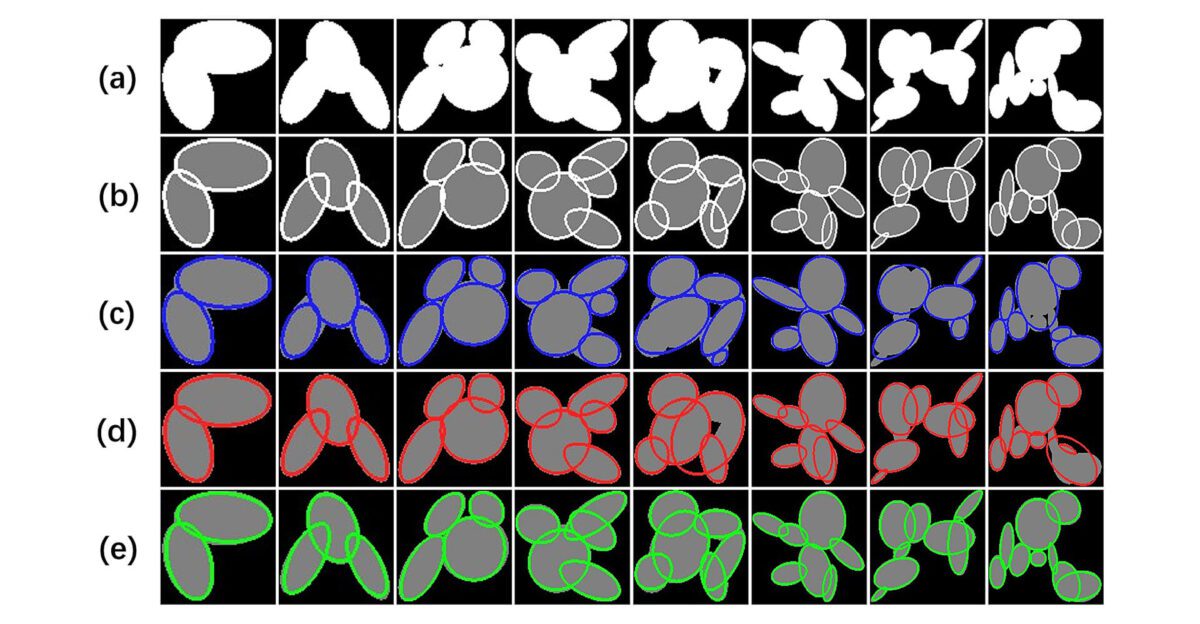
Figure 9 from the study shows examples of ellipse fitting results for the synthetic test set: (a) original binary image, (b) ground truth, (c) results from Panagiotakis et al. (2018) model, (d) results from Zafari et al. (2016) model and (e) results from the proposed method. The number of true ellipses increased from two (leftmost column) to nine (rightmost column).
Posted November 30, 2021
Researchers from the Center for Statistics and Applications in Forensic Evidence (CSAFE) have developed a novel approach for identifying overlapping objects in a binary image by approximating them with ellipses. The method is intended to be applied to complex-shaped regions—or clumps—composed of one or more overlapping objects.
The proposed approach, detailed in a study published in Pattern Analysis and Applications, could be suitable for various image analysis applications, including bloodstain pattern analysis. Characteristics of the approximating ellipses will be used in future research to help assess evidence regarding the mechanism that produced a given bloodstain pattern.
The study was led by Tong Zou and Tianyu Pan, graduate students in statistics at the University of California, Irvine (UCI); and Hal Stern, CSAFE co-director and Chancellor’s Professor of statistics at UCI. The late Michael Taylor, a science leader at the Institute of Environmental Science and Research in New Zealand, contributed to the study.
The computational method the researchers developed can identify the individual objects making up each clump. The method consists of two main steps. The first step generates a large number of elliptical shapes that match the overall contours of the clump. Then the set of candidate ellipses are reduced using an empirical measure of fit. In the second step, the concave points in the clump’s contour are identified and an optimization is set up to determine the best fitting ellipses.
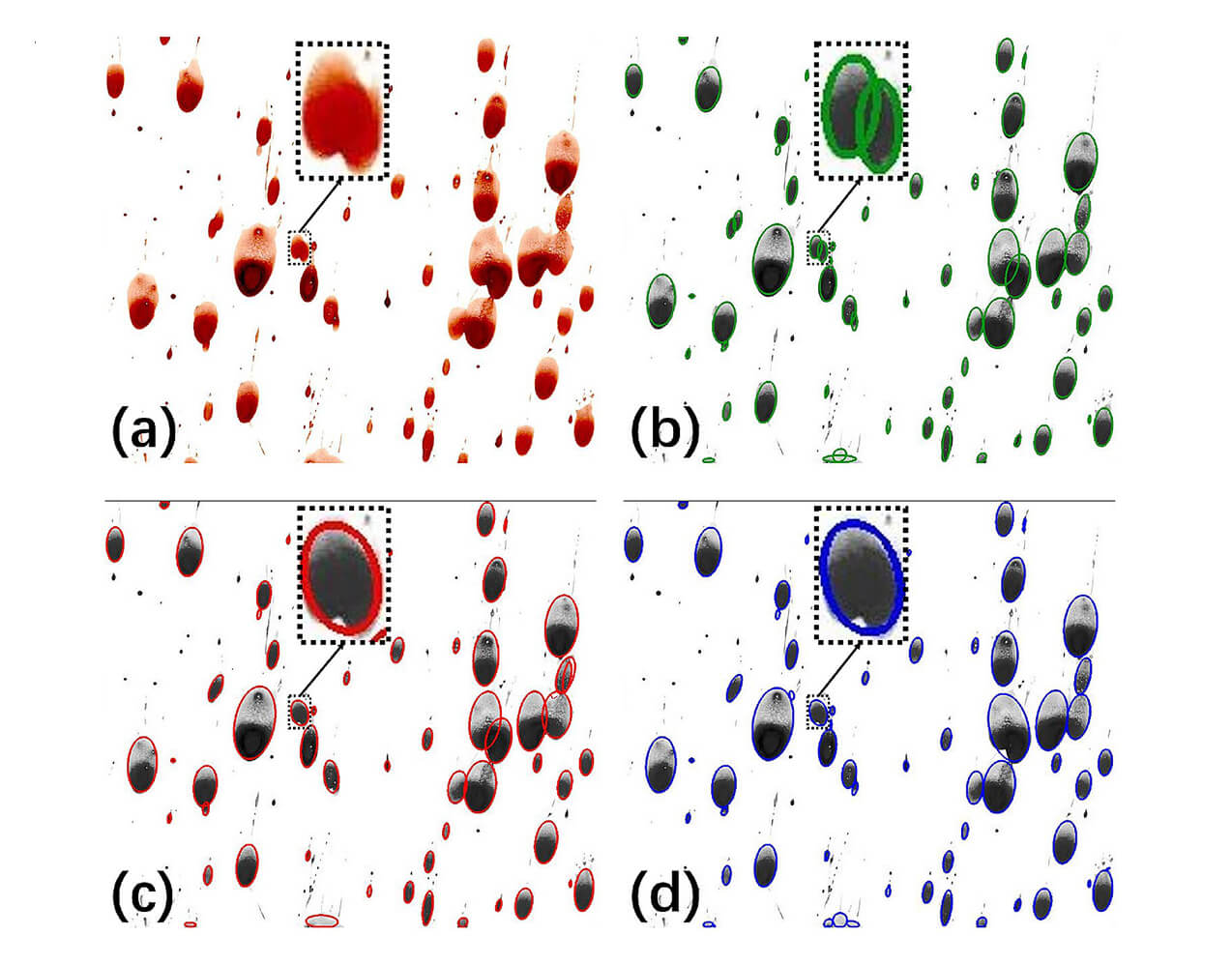
The researchers tested the performance of their new method in a number of ways. They developed a dataset of 1,600 simulated binary images. Each image contained one connected region made up of multiple overlapping ellipses. They compared the proposed method against two existing models using four measures for assessing the performance of detecting overlapping elliptical objects.
Results from the test with synthetic data showed that the new method outperformed the existing methods. The researchers noted that even as the number of ellipses in the synthetic images increased, potentially complicating the task, the proposed method was able to maintain consistent accuracy while the existing methods struggled to correctly recognize shapes.
The research team also applied their method to datasets from two scientific applications: biological images used to identify cells and bloodstain patterns. For the cell splitting test, they reported that the new method managed to accurately split most touching cells and showed notable improvement over an existing method.
For the bloodstain pattern experiment, the researchers noted that there is currently no way to quantify the performance of the methods for bloodstain pattern analysis, so it was assessed based on a visual inspection. Results were consistent with those in the simulation study and the new method seemed to do well.
“Through a set of computational and optimization efficiencies, we are able to apply our approach in complex images comprised of a number of overlapped regions. Experimental results on a synthetic data set, two types of cell images and bloodstain patterns show superior accuracy and flexibility of our method in ellipse recognition, relative to other methods,” the researchers wrote in the study.
Code for implementing the proposed approach is available at https://github.com/zout3/overlapping-ellipses-recognition.
Datasets used in the study can be found with these publications:
- Cell dataset: https://www.ncbi.nlm.nih.gov/pmc/articles/PMC2901896/
- Bloodstain pattern dataset: https://www.ncbi.nlm.nih.gov/pmc/articles/PMC5996142/
View and download the journal article at https://forensicstats.org/blog/portfolio/recognition-of-overlapping-elliptical-objects-in-a-binary-image/.
View insights from this study at https://forensicstats.org/blog/2021/05/13/insights-recognition-of-overlapping-elliptical-objects-in-a-binary-image/.
Learn more about CSAFE’s research on bloodstain pattern analysis at https://forensicstats.org/blood-pattern-analysis/.
From the Blog

Recent Posts
Keynote Speakers Announced for ICFIS 2026
August 10, 2026
The Scientific Committee for the 12th International Conference on Forensic Inference and Statistics is pleased to announce the keynote speakers …
CSAFE Researchers will be Panel Speakers at NAFSB 2026 Conference
August 7, 2026
The annual National Association of Forensic Science Boards (NAFSB) Conference will be Oct. 13-16 at the Milwaukee Crime Lab Bureau …
ICFIS 2026 Moves Online, Abstract Deadline Extended to Aug. 17
July 27, 2026
The 12th International Conference on Forensic Inference and Statistics (ICFIS) will now be an online-only event, allowing participants from around the world …