
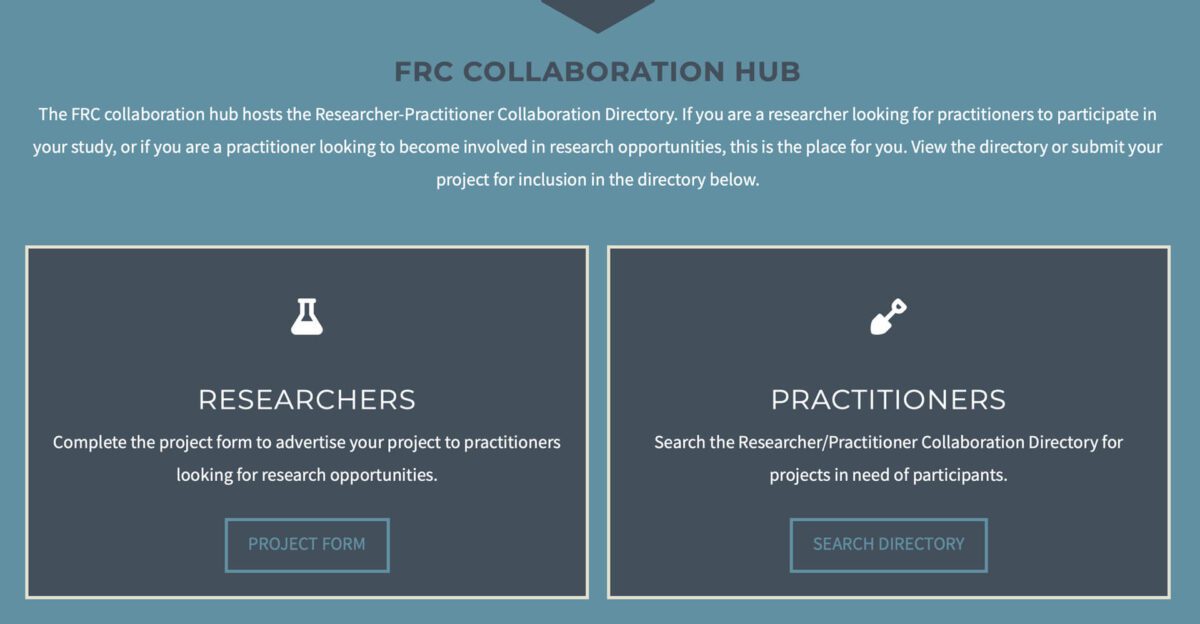
The Researcher-Practitioner Collaboration Directory can be found on the Forensic Research Committee’s webpage at www.ascld.org/forensic-research-committee.
Posted April 25, 2022
Forensic practitioners looking to become involved in Center for Statistics and Applications in Forensic Evidence (CSAFE) research can now find a list of research opportunities in the American Society of Crime Laboratory Directors (ASCLD) Forensic Research Committee’s (FRC) Researcher-Practitioner Collaboration Directory.
The directory connects researchers with ongoing projects to practitioners who want to participate in research studies. Each project listed in the directory includes a summary, the support requested from participants, estimated time involved and deliverables. To request to collaborate, practitioners can contact the principal investigator.
CSAFE currently has six projects in the directory that could use the support from forensic practitioners or law enforcement personnel. The principal investigator and the support requested for each project are listed below. More information about these projects can be found in the FRC Researcher-Practitioner Collaboration Directory at www.ascld.org/researcher-practitioner-collaboration-directory.
To learn more about CSAFE research in pattern and digital evidence, visit forensicstats.org/our-research.
Research Collaboration Opportunities:
Blind Proficiency Testing
Robin Mejia, Carnegie Mellon University
Support Requested: Researchers will collaborate with labs that conduct blind proficiency testing or are considering it. Collaborations can range from a single discussion to ongoing logistical or analytical support, including connecting those who would be interested in inter-lab collaboration.
Characterization of Footwear in Local Populations
Susan VanderPlas, University of Nebraska-Lincoln
Support Requested: Researchers are looking for practitioners and law enforcement partners to collect footwear data from local populations using scanning equipment.
Forensic Processing at Crime Labs
Brett Gardner, University of Virginia
Support Requested: In recent years, CSAFE researchers have successfully collaborated with crime laboratories to examine case processing variables and clarify workflow procedures in latent print comparison units. Researchers are seeking to collaborate with laboratory personnel to generate and answer questions about each laboratory’s case processing and workflow. The collaboration will aim to answer the laboratories’ specific questions and inform the larger field of case processing within latent print units.
Handwriting Evaluation
Alicia Carriquiry, Iowa State University
Support Requested: Participants will be asked to provide handwriting samples in three data collection sessions. In each session, participants will complete a short survey and transcribe the contents of three prompts. In an upcoming project phase, researchers will ask participants to test CSAFE’s handwriter package on their handwriting samples and provide feedback on the user interface, capabilities, limitations, usefulness and other usability features.
Mobile App Evidence Analysis
Yong Guan, Iowa State University
Support Requested: The researchers will work with crime lab practitioners to better understand the frequently used digital evidence types in casework, areas of confusion and potential errors in communicating and analyzing these evidence types. The researchers hope to understand what factors limit the practitioners’ efficacy and efficiency in their daily casework.
StegoAppDB: Reference Database with Variational Sources for Mobile Steganography Image Forensics
Jennifer Newman, Iowa State University
Support Requested: Researchers are available to discuss the issues with steganography/digital image forensics the crime lab currently has or is looking to address in the future. If a topic of mutual interest is identified, researchers will work with the lab to identify some aspect of the issue that could be studied.
From the Blog
Two Journals for Sharing Your Forensic Science and Statistics Research
If you’re looking for a journal to showcase your latest research findings, consider exploring these …
NIST Report Highlights Key Challenges in Forensic Science and Provides Strategies for Addressing Them
In September, the National Institute of Standards and Technology (NIST) released a new report titled …
Recent Posts
Keynote Speakers Announced for ICFIS 2026
August 10, 2026
The Scientific Committee for the 12th International Conference on Forensic Inference and Statistics is pleased to announce the keynote speakers …
CSAFE Researchers will be Panel Speakers at NAFSB 2026 Conference
August 7, 2026
The annual National Association of Forensic Science Boards (NAFSB) Conference will be Oct. 13-16 at the Milwaukee Crime Lab Bureau …
ICFIS 2026 Moves Online, Abstract Deadline Extended to Aug. 17
July 27, 2026
The 12th International Conference on Forensic Inference and Statistics (ICFIS) will now be an online-only event, allowing participants from around the world …