
Posted September 29, 2017
Solving inverse problems in forensic science pose a complex challenge but CSAFE researchers are simplifying the process through the incorporation of statistical modeling.
An inverse problem requires that you start with the results, and then calculate the cause. CSAFE Carnegie Mellon post-doctoral research associate Dr. Lotem Kaplan explains how inverse problems apply in a criminal investigation. “In a crime scene you have all these clues and you’re trying to understand what actions took place, where things were and when everything happened,” she said.
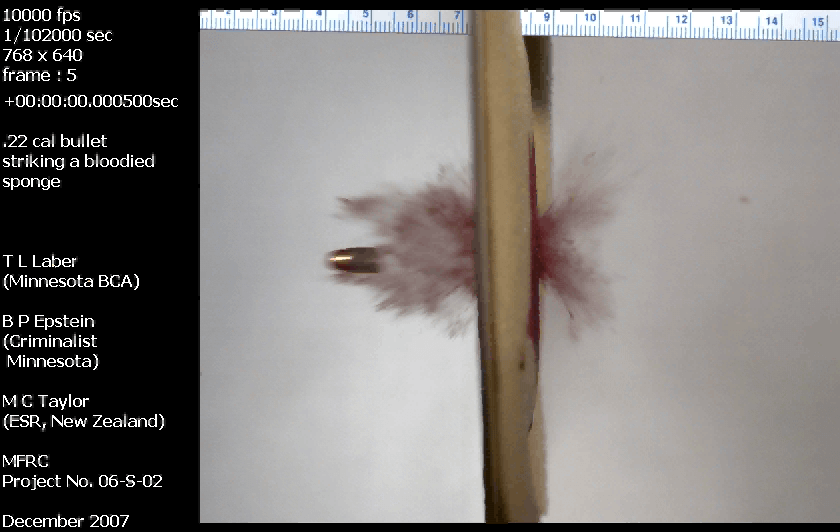
“A simple example is blood spatter,” said CSAFE Co-director and Carnegie Mellon University Professor of Statistics Dr. Bill Eddy. “You have to determine did the blood come because somebody got shot with a bullet, did it come because somebody got hit with a baseball bat? You have to determine if the pattern of the blood on the wall tells you anything about what happened.”
CSAFE researchers are exploring how blood behaves through the development of new software tools that model the trajectory of a blood sample. The team uses a collection of publicly available videos of blood experiments from Ames Laboratory. The videos contain, for example, shots of blood dripping from different objects onto different surfaces from different heights.
“Understanding that the same blood drop can cause very different stains based on velocity and surface and height is important,” Dr. Kaplan said. “It is a very complicated problem because it’s not something that always gives you the same result, there are so many different parameters that should be considered when you look at the stain.”
Dr. Eddy explains that currently, blood spatter analysts draw lines backwards from the spatter and try to figure out where they converge, or where an action happened.
“It’s certainly a first approximation, but it obviously doesn’t apply to every problem,” Dr. Eddy said. “If you think about a guy that was standing on a ladder when he got shot, the bullet was going up and the blood is going to come down because of gravity, so the straight lines aren’t going to cut it.”
The CSAFE software breaks down the video into frames and processes each of those frames to extract the drop of blood from the rest of the image. Researchers then separate the motion of the blood drop from its change in shape by giving a mathematical description to both the drop of blood as well as to its location in the image.
“The objective will be to determine the likelihood surface, quantifying uncertainty and provide a coherent framework for the interpretation of the results,” Eddy said.
Researchers also extracted the location of the drop throughout its fall and inferred its velocity, which they used to model velocity for two different heights. In addition, researchers modeled the stain formation by looking at drops that fall on the same surface and then measuring the width of the stain over time as the stain is formed.
Using these models, researchers produced a video of an experiment that never took place, modeling a drop of blood falling from a new height. Dr. Kaplan explained that by using statistical data that comes from real life experiments, researchers are adding increased validity to blood spatter analysis.
The results of research thus far are a preliminary foundation that the CSAFE teams plan to build on through collaborations with additional researchers and applications across multiple forensic science disciplines.
In order to better understand how these new methods can apply to the everyday work of blood spatter analysts, Dr. Eddy, Dr. Kaplan, and other members of the CSAFE team are collaborating with forensic science practitioners from Allegheny County Medical Examiner’s Office.
“If you want to influence a community you have to collaborate with it, hear how they do things, learn what challenges they are facing, and understand how they make a decision,” said Dr. Kaplan.
CSAFE researchers’ goal is to continue expanding partnerships with practitioners, working alongside them to help quantify blood spatter analysis results and bring more confidence to the conclusions. To learn more about this project and other CSAFE work visit our research page.
From the Blog
Two Journals for Sharing Your Forensic Science and Statistics Research
If you’re looking for a journal to showcase your latest research findings, consider exploring these …

NIST Report Highlights Key Challenges in Forensic Science and Provides Strategies for Addressing Them
In September, the National Institute of Standards and Technology (NIST) released a new report titled …
Recent Posts
Keynote Speakers Announced for ICFIS 2026
August 10, 2026
The Scientific Committee for the 12th International Conference on Forensic Inference and Statistics is pleased to announce the keynote speakers …
CSAFE Researchers will be Panel Speakers at NAFSB 2026 Conference
August 7, 2026
The annual National Association of Forensic Science Boards (NAFSB) Conference will be Oct. 13-16 at the Milwaukee Crime Lab Bureau …
ICFIS 2026 Moves Online, Abstract Deadline Extended to Aug. 17
July 27, 2026
The 12th International Conference on Forensic Inference and Statistics (ICFIS) will now be an online-only event, allowing participants from around the world …