
Posted February 24, 2021
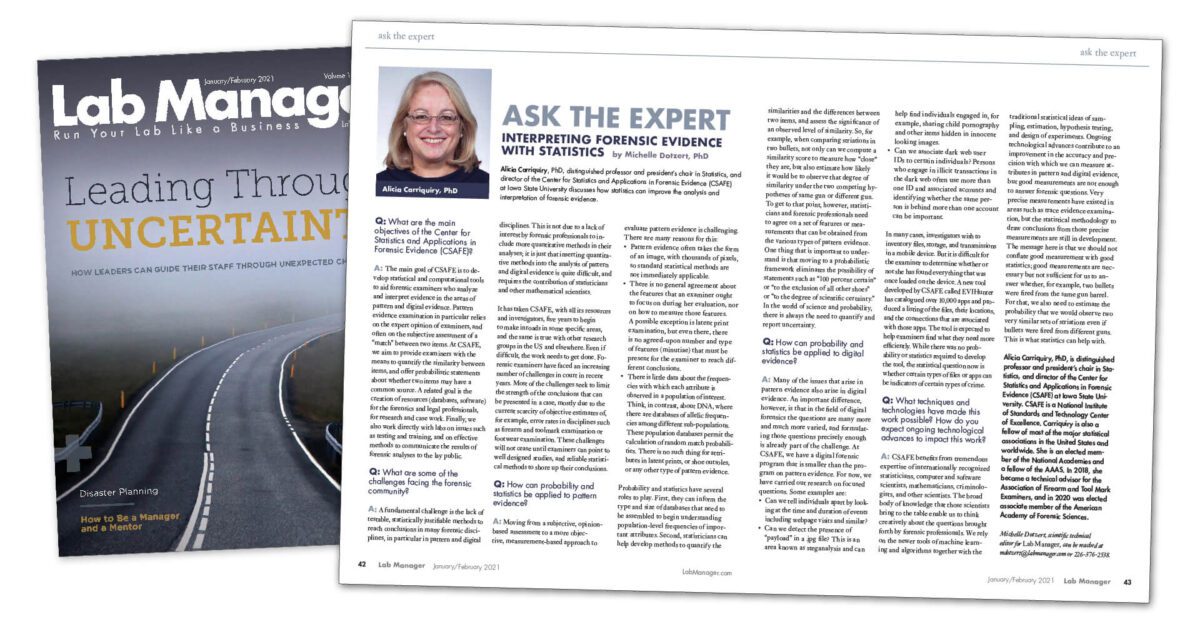
Alicia Carriquiry, the director of the Center for Statistics and Applications in Forensic Evidence (CSAFE), was featured in the “Ask the Expert” column of the January-February issue of Lab Manager magazine. The column topic was titled, “Interpreting Forensic Evidence with Statistics.”
In a Q&A format, Carriquiry gave a detailed overview of CSAFE’s pattern and digital evidence research. She also discussed how statistics could improve the analysis and interpretation of forensic evidence.
Excerpt from the article:
Q: What techniques and technologies have made this work possible? How do you expect ongoing technological advances to impact this work?
A: CSAFE benefits from tremendous expertise of internationally recognized statisticians, computer and software scientists, mathematicians, criminologists, and other scientists. The broad body of knowledge that those scientists bring to the table enable us to think creatively about the questions brought forth by forensic professionals. We rely on the newer tools of machine learning and algorithms together with the traditional statistical ideas of sampling, estimation, hypothesis testing, and design of experiments. Ongoing technological advances contribute to an improvement in the accuracy and precision with which we can measure attributes in pattern and digital evidence, but good measurements are not enough to answer forensic questions. Very precise measurements have existed in areas such as trace evidence examination, but the statistical methodology to draw conclusions from those precise measurements are still in development. The message here is that we should not conflate good measurement with good statistics; good measurements are necessary but not sufficient for us to answer whether, for example, two bullets were fired from the same gun barrel. For that, we also need to estimate the probability that we would observe two very similar sets of striations even if bullets were fired from different guns. This is what statistics can help with.
Read the entire article at https://www.labmanager.com/ask-the-expert/interpreting-forensic-evidence-with-statistics-25029.
From the Blog
Two Journals for Sharing Your Forensic Science and Statistics Research
If you’re looking for a journal to showcase your latest research findings, consider exploring these …
NIST Report Highlights Key Challenges in Forensic Science and Provides Strategies for Addressing Them
In September, the National Institute of Standards and Technology (NIST) released a new report titled …
Recent Posts
Keynote Speakers Announced for ICFIS 2026
August 10, 2026
The Scientific Committee for the 12th International Conference on Forensic Inference and Statistics is pleased to announce the keynote speakers …
CSAFE Researchers will be Panel Speakers at NAFSB 2026 Conference
August 7, 2026
The annual National Association of Forensic Science Boards (NAFSB) Conference will be Oct. 13-16 at the Milwaukee Crime Lab Bureau …
ICFIS 2026 Moves Online, Abstract Deadline Extended to Aug. 17
July 27, 2026
The 12th International Conference on Forensic Inference and Statistics (ICFIS) will now be an online-only event, allowing participants from around the world …