
Posted November 10, 2019
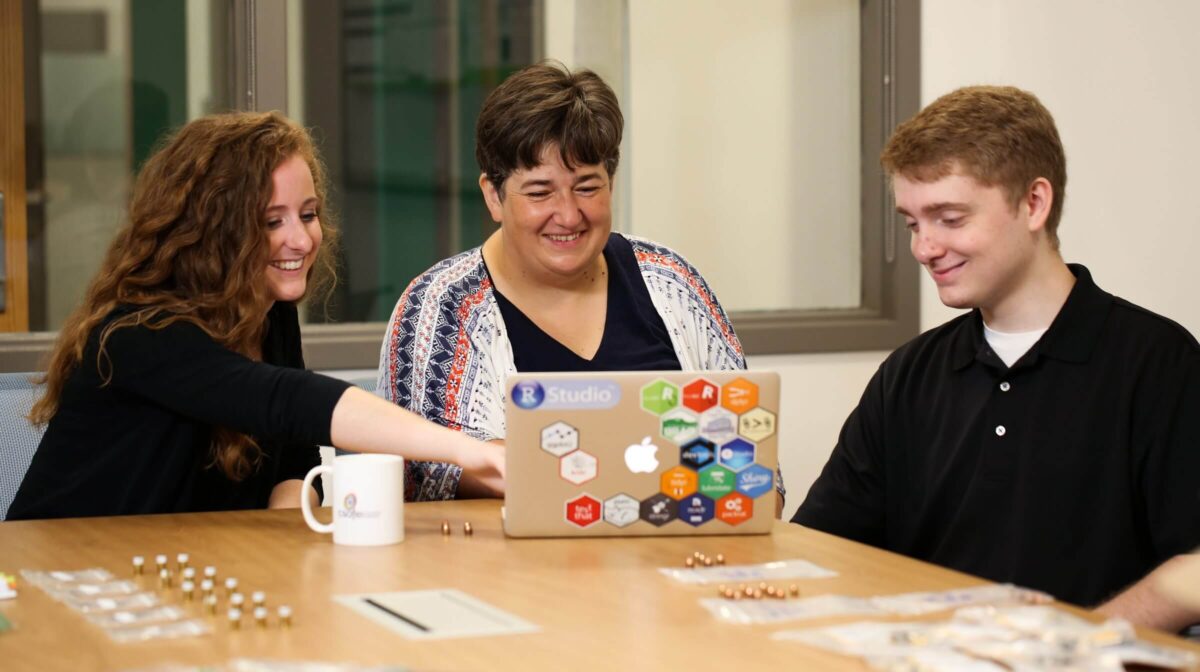
[vc_row][vc_column][vc_custom_heading text=”Equipping Tomorrow’s Leaders” font_container=”tag:h1|font_size:18|text_align:left” use_theme_fonts=”yes”][vc_column_text css=”.vc_custom_1574445149160{margin-bottom: 0px !important;}”]CSAFE researchers are passionate about working with the next generation of forensic scientists. Our post-doctoral fellows, graduate student researchers, and undergraduate students play a vital role in the development and implementation of CSAFE’s mission and goals. Students work on complex and challenging projects in areas such as human factors, firearms and toolmarks, and handwriting and shoeprints.
Through one-on-one mentorship, group learning and professional development training, CSAFE helps students become proficient in data collection, analysis, and interpretation. Our students also grow their professional networks through collaborations with forensic science experts across the world.
Hear from our students on how we prepare them to make a difference in their future careers.[/vc_column_text][vc_separator][/vc_column][/vc_row][vc_row][vc_column width=”1/2″][vc_single_image image=”3949″ img_size=”full”][/vc_column][vc_column width=”1/2″][vc_custom_heading text=”Hands-On Learning” font_container=”tag:h3|text_align:left” use_theme_fonts=”yes”][vc_column_text css=”.vc_custom_1574445279331{margin-bottom: 0px !important;}”]”I think something you get CSAFE that you wouldn’t get it maybe another program is that hands on experience, that ability to work with faculty, one on one, work with postdocs and graduate students on their projects. It’s really cool to have an actual hand in the research. You’re not necessarily given a cookie cutter task, your opinion is taken into account, and they allow you to learn, while you working on the research projects.”
-James Kruse, Master’s Student- Sociology, Bio-Medical Science and Genomics[/vc_column_text][/vc_column][/vc_row][vc_row][vc_column width=”1/2″][vc_single_image image=”4191″ img_size=”full”][/vc_column][vc_column width=”1/2″][vc_custom_heading text=”Community Connections” font_container=”tag:h3|text_align:left” use_theme_fonts=”yes”][vc_column_text css=”.vc_custom_1574445325676{margin-bottom: 0px !important;}”]”The biggest success I’ve had at CSAFE was my trip to the Association of Firearm and Tool Mark Examiner conference. CSAFE is really good at giving students opportunities to present their work and make connections with people in the forensic community. I got to talk to actual firearms examiners one-on-one about the work I’ve been doing. One of the biggest things I’ve learned at CSAFE is to get feedback from practitioners and learn more about the actual process.”
-Kiegan Rice, PhD Student- Statistics[/vc_column_text][/vc_column][/vc_row][vc_row][vc_column width=”1/2″][vc_single_image image=”4193″ img_size=”full”][/vc_column][vc_column width=”1/2″][vc_custom_heading text=”Interdisciplinary Collaboration” font_container=”tag:h3|text_align:left” use_theme_fonts=”yes”][vc_column_text css=”.vc_custom_1574445351245{margin-bottom: 0px !important;}”]”The strongest motivators that really drew me to contribute was the emphasis on interdisciplinary sciences. It’s really difficult to come across opportunities where you have the software engineer alongside a statistician with a biologist just down the hall where you’re all able to communicate your ideas and approaches to different problems with one another. This is definitely an irreplaceable environment.”
-Ben Escobar, Undergraduate Student-Computer Science and BioInformatics[/vc_column_text][/vc_column][/vc_row][vc_row][vc_column width=”1/2″][vc_single_image image=”4192″ img_size=”full”][/vc_column][vc_column width=”1/2″][vc_custom_heading text=”Data-Driven” font_container=”tag:h3|text_align:left” use_theme_fonts=”yes”][vc_column_text css=”.vc_custom_1574445367807{margin-bottom: 0px !important;}”]”CSAFE focuses on the data, which I think is really important. It really teaches young researchers to focus on the evidence, and to focus on that data, and to use the data to help improve the science.”
-Samantha Tyner, Former PhD Student and Post-Doc- Statistics[/vc_column_text][/vc_column][/vc_row]
From the Blog
Two Journals for Sharing Your Forensic Science and Statistics Research
If you’re looking for a journal to showcase your latest research findings, consider exploring these …
NIST Report Highlights Key Challenges in Forensic Science and Provides Strategies for Addressing Them
In September, the National Institute of Standards and Technology (NIST) released a new report titled …
Recent Posts
Keynote Speakers Announced for ICFIS 2026
August 10, 2026
The Scientific Committee for the 12th International Conference on Forensic Inference and Statistics is pleased to announce the keynote speakers …
CSAFE Researchers will be Panel Speakers at NAFSB 2026 Conference
August 7, 2026
The annual National Association of Forensic Science Boards (NAFSB) Conference will be Oct. 13-16 at the Milwaukee Crime Lab Bureau …
ICFIS 2026 Moves Online, Abstract Deadline Extended to Aug. 17
July 27, 2026
The 12th International Conference on Forensic Inference and Statistics (ICFIS) will now be an online-only event, allowing participants from around the world …