
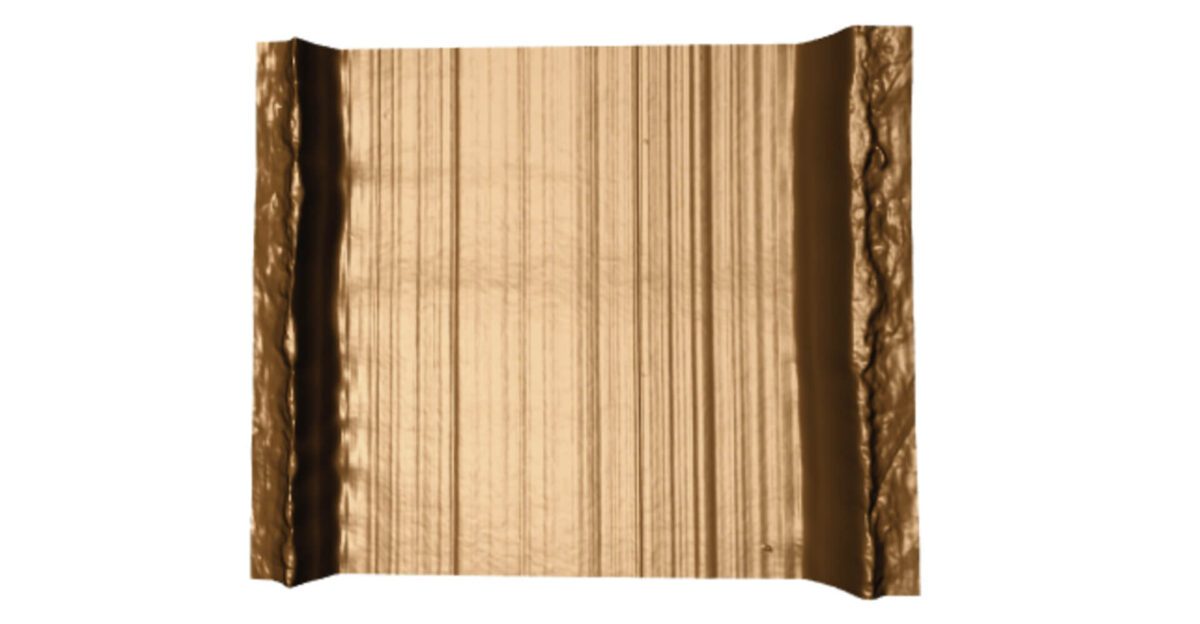
A 3D scan of one toolmark made by a screwdriver.
Posted December 13, 2024
A new foundational study by the Center for Statistics and Applications in Forensic Evidence (CSAFE) introduces an algorithm designed to enhance the reliability and objectivity of forensic toolmark analysis.
The study, published in Forensic Science: Synergy, was led by Maria Cuellar, an assistant professor of criminology and statistics and data science at the University of Pennsylvania; Sheng Gao, a former graduate student at the University of Pennsylvania; and Heike Hofmann, a professor of statistics at the University of Nebraska-Lincoln.
Forensic toolmark analysis has traditionally faced challenges due to the complex variables involved, such as the angles and directions from which marks are generated. To address these issues, the research team created a comprehensive dataset of 3D toolmarks derived from a series of consecutively manufactured slotted screwdrivers.
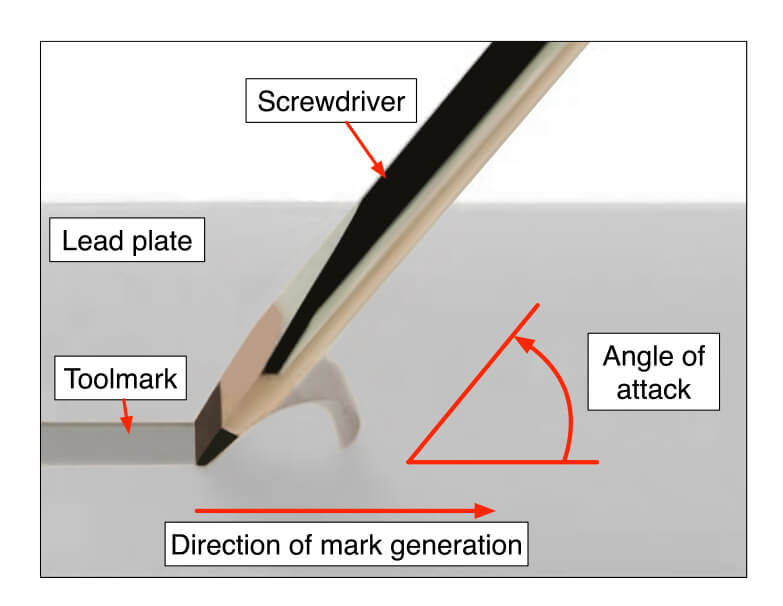
The researchers employed a factorial design to study toolmark variability across different angles and directions of attack, generating a total of 560 distinct marks across multiple experimental conditions. This systematic approach highlights the variability in marks produced even by the same tool. The experiments utilized specially designed rigs and lead plates to ensure controlled and replicable toolmark generation, maximizing the detail preserved in each mark.
The research team utilized a Partitioning Around Medoids (PAM) clustering method to analyze the data. Their findings indicate toolmark similarities cluster by tool rather than angle or direction. The study establishes thresholds for classification based on Known Match and Known Non-Match densities, enabling the calculation of likelihood ratios for new toolmark pairs.
The algorithm demonstrates a cross-validated sensitivity of 98% and specificity of 96%, significantly enhancing the reliability of toolmark analysis.
“Our goal was to develop a method that not only improves the accuracy of toolmark analysis but also provides a transparent and reproducible process for forensic examiners,” said Cuellar. “By leveraging 3D technology and advanced algorithms, we hope to enhance the credibility of forensic evidence in the legal system.”
The researchers hope that with further data collection, their algorithm can be adapted to analyze toolmarks from a wider variety of tools, significantly impacting the field of forensic science. As an open-source solution, the original datasets generated in this study will soon be made available to researchers and forensic professionals.
For more information about the use of algorithms in forensic science, check out this CSAFE Learning opportunity: “Algorithms for Forensic Science,” presented by Henry Swofford, lead scientist with the Forensic Science Research Program in the Special Programs Office at NIST.
From the Blog
Two Journals for Sharing Your Forensic Science and Statistics Research
If you’re looking for a journal to showcase your latest research findings, consider exploring these …

NIST Report Highlights Key Challenges in Forensic Science and Provides Strategies for Addressing Them
In September, the National Institute of Standards and Technology (NIST) released a new report titled …
Recent Posts
Keynote Speakers Announced for ICFIS 2026
August 10, 2026
The Scientific Committee for the 12th International Conference on Forensic Inference and Statistics is pleased to announce the keynote speakers …
CSAFE Researchers will be Panel Speakers at NAFSB 2026 Conference
August 7, 2026
The annual National Association of Forensic Science Boards (NAFSB) Conference will be Oct. 13-16 at the Milwaukee Crime Lab Bureau …
ICFIS 2026 Moves Online, Abstract Deadline Extended to Aug. 17
July 27, 2026
The 12th International Conference on Forensic Inference and Statistics (ICFIS) will now be an online-only event, allowing participants from around the world …