
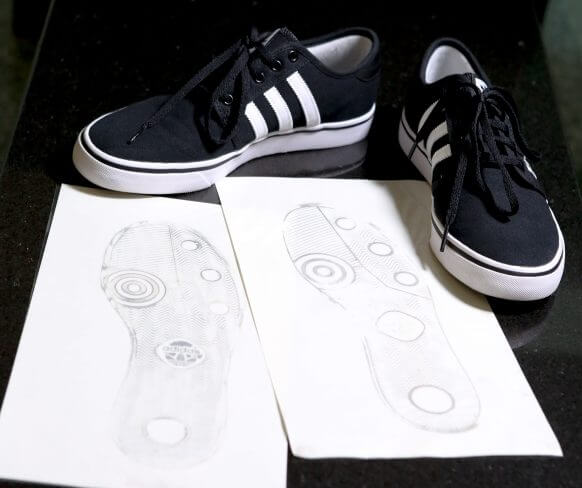
This CSAFE Center Wide webinar was presented on March 11, 2019 by Dr. Soyoung Park, CSAFE Post Doctoral researcher at Iowa State University. Dr. Park has provided presentation slides.
Presentation Description:
Shoe outsole prints are often found in crime scenes. If a suspect is apprehended and her shoes are potential sources of the prints in the crime scene, how might a forensic scientist go about quantifying the degree of similarity between the two? As is the case for most other types of pattern evidence, quantifying the similarity between two impressions is challenging. The traditional statistical modeling approach is not appropriate in these cases, so we turn to learning algorithms as a potential alternative. In this talk, we discuss a method that compares two dimensional images, one of a latent crime scene print, and one of a known shoe, and produces a score that quantifies the degree of similarity between the two. The method we have developed is promising, because it appears to correctly determine with high probability whether two images have a common or a different source, at least for the shoes on which we have experimented.
Related Resources


Forensic Footwear: A Retrospective of the Development of the MANTIS Shoe Scanning System
July 10, 2025
There currently are no shoe-scanning devices developed in the United States that can operate in a real-world, variable-weather environment in …

Examiner consistency in perceptions of fingerprint minutia rarity
July 10, 2025
Friction ridge examiners (FREs) identify distinctive features (minutiae) in fingerprints and consider how rare these observed minutiae are in their …